Trial of John Christ Murder Case
The HollowThe inquest into John Christow's death converts a private catastrophe at The Hollow into an official finding while leaving its central question unresolved. It establishes that John Christow died by wilful murder, but the verdict names no culprit, allowing the legal process to close only provisionally while Inspector Grange and Hercule Poirot continue to pursue a fuller account of what happened.
Purpose and Background
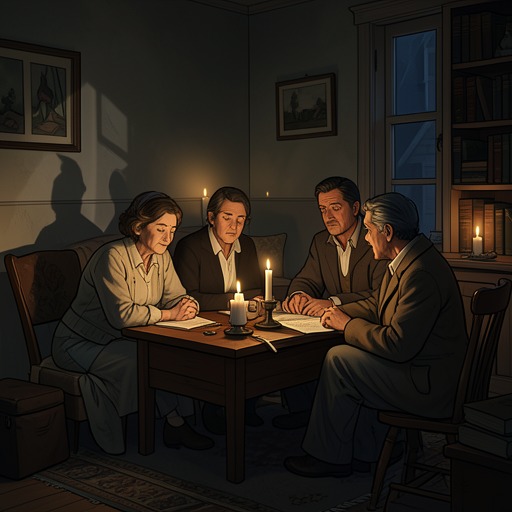
The proceeding follows John Christow's shooting at the swimming pool and the police examination of the scene and body. Inspector Grange initially tells Gerda Christow that the inquest will be simple and that it will probably be adjourned for a week while further inquiries are made. Gerda, dressed in black and looking nervous and bewildered, is treated as a bereaved widow, yet Inspector Grange already regards her as the principal suspect. The contrast between her public position and the suspicion directed toward her shows how the inquest begins with a gap between social appearance and investigative knowledge.
The inquiry is also complicated by the fact that the revolver identified by Sir Henry Angkatell was not the weapon that shot John Christow. Inspector Grange informs Sir Henry of this directly, making clear that the object found at the scene cannot by itself settle the question of who fired the fatal shot. A letter associated with Veronica Cray, beginning with an invitation to come over because she must see John, supplies another strand of suspicion and links the investigation to concealed personal history rather than to an isolated act of violence.
Conduct and Delay
The first inquest is described as the merest formality, and its procedural modesty produces an almost comic sense of anti-climax among those who had been warned to expect little. The police request an adjournment for a fortnight, extending the period in which the household remains suspended between mourning and accusation. The delay does not resolve the case; instead, it preserves uncertainty while the police examine contradictory evidence and the people connected with John Christow.
The legal proceeding is therefore only one of several truth-producing mechanisms in the story. Inspector Grange's notebook, the examination of the body, the identification of the revolver, the letter from Veronica Cray, and the pursuit of fingerprints each carry a different evidentiary authority. The inquest can record the manner of death, but it cannot transform every suspicious circumstance into a proven identity. Its restraint exposes the difference between establishing murder and proving who committed it.
Verdict
At the later hearing, the coroner prompts the jury, and the foreman reads the formal conclusion: "We find that the deceased came to his death by wilful murder by some person or persons unknown." The verdict confirms deliberate killing while refusing to assign responsibility. Hercule Poirot quietly nods because, given the available proof, there could be no other possible verdict. The wording is decisive and evasive at once: John Christow was murdered, but the murderer remains legally unnamed.
The verdict leaves the surrounding characters in the same emotional and social uncertainty that marked the earlier proceedings. Gerda Christow still wears the same black clothes and retains the same dazed, unhappy expression. The Angkatells speak with her outside, and the ordinary arrangements of travel and departure resume around a death that has not been morally or psychologically settled. The formal conclusion thus creates closure in the record without creating closure in the household.
Grief, Performance, and Concealment
The inquest's restraint is set against the elaborate social management of mourning at The Hollow. After the death, Lucy Angkatell serves cold ducks and caramel custard, explaining that a favourite pudding would seem too gross immediately after the death of a friend, whereas caramel custard expresses a more delicate, socially acceptable feeling. Food becomes a ritual language through which the household attempts to regulate the visible form of grief.
Henrietta Savernake rejects that regulation when she tells Edward Angkatell that she wants to be alone with her dead. She experiences John's death as a sudden transformation from living presence to emptiness and repeats the word "Dead" until it loses meaning. Later, when she finally believes she has time to grieve, the emotional force of John's absence breaks through the purposeful control she had maintained. Mrs. Crabtree's rough consolation that what is gone cannot be recovered and Hercule Poirot's more measured understanding express the same finality in different registers.
Henrietta's grief is inseparable from concealment. She worries that any revelation about her relationship with John would impose an added burden on Gerda, insisting that Gerda adored him and had already lost him. Her concern is ethically complicated by her admission that she had been John's mistress, but the inquest's public search for a murderer does not accommodate the private distinctions among love, guilt, loyalty, and protection. What matters legally is the identity of the killer; what matters to Henrietta is whether truth will further injure the living.
Aftermath and Significance
The inquest is not the end of the investigation. When Henrietta warns Hercule Poirot that the police will search for the owner of fingerprints and may eventually let the matter drop, she understands that Poirot will not abandon the truth merely because the official process has reached an inconclusive verdict. Poirot confirms that he will not let it drop, preserving a tension between legal sufficiency and investigative or moral completeness.
The later discovery of the leather fragments that form a holster sharpens that tension. Poirot reconstructs the object and proposes that Gerda Christow, overwhelmed by her husband's death, could be recorded as having taken her own life while of unsound mind. The prospect of such an ending shows how the case can be redirected from murder to suicide through a combination of physical evidence, compassion, and deliberate concealment. Henrietta can then grieve, but her grief remains joined to the knowledge that the truth has been shaped to protect Gerda and others.
As an event, the inquest embodies the novel's opposition between public verdict and private truth. It names the death, classifies it as murder, and preserves the authority of law, yet it does not disclose the full chain of motives, loyalties, and protective acts surrounding John Christow's death. Its apparent incompleteness is therefore structurally important: the courtroom can determine what happened to John in the narrowest forensic sense, while the wider narrative asks what truth the survivors can bear and what kind of justice remains when full disclosure would produce further destruction.